Back to Blog
Web DevAssisted by GPT4

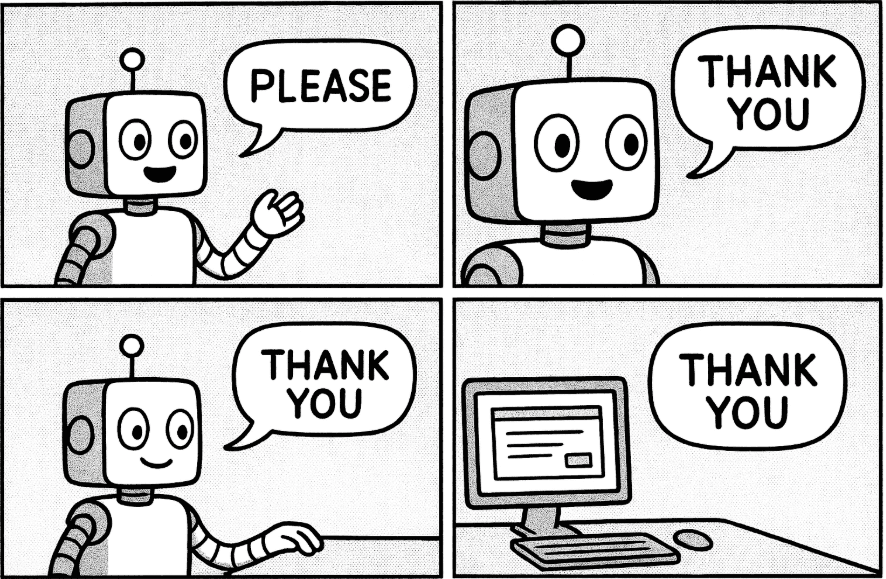
Polite Prompts: Please, Thank You, and Better AI Responses

Are 'please' and 'thank you' just wasted CPU cycles, or do they actually make us better prompters? Here's my take on why being polite might just be good prompt engineering.
September 29, 2025
AIPrompt EngineeringDeveloper DiaryEthicsThought Piece
Polite Prompts: Please, Thank You, and Better AI Responses

šŸ¤– Polite Prompts: Please, Thank You, and Better AI Responses

I joke a lot about saying please and thank you to my AI models, agents, and tools — but recently, I’ve heard I shouldn’t be doing that.

At first, that sounded silly to me. But then I thought about it: every time I type ā€œthank you,ā€ it’s processed, aggregated, analyzed, checked, and rendered back to me. Multiply that by millions of people doing the same thing, all day, every day — and yes, that’s a lot of CPU cycles burned just for politeness.


⚔ The "Thank You" Tax

From a systems perspective, ā€œthank youā€ doesn’t carry much context. I imagine the model probably doubles back internally to figure out what I’m thanking it for so it can give a meaningful response, even though I don’t need one.

I get it — that’s extra compute, extra energy, maybe even unnecessary. But here’s the thing: there are far bigger wastes of resources happening in AI prompt-land than me being polite. So why does this feel like such a hot take?


🧠 Why I Still Do It

Here’s my theory:

  • People who say ā€œthank youā€ might actually care about the conversation and will listen to what comes back.
  • People who are rude to AI probably aren’t going to suddenly become polite just because you tell them to.

So I’m keeping my please and thank you — not as single throwaway messages, but as part of my longer, more thoughtful prompts.


šŸ’” Does Politeness Actually Improve AI Output?

Here’s the interesting part: when I write prompts where please and thank you fit naturally, I consistently get better results.

Why? My working theory:

  • When I take the time to phrase things kindly, I’m also taking the time to be clear and complete.
  • Clear prompts produce better outputs.
  • Maybe, just maybe, the model is matching my tone and giving me a ā€œnicerā€ answer.

It’s like programming — garbage in, garbage out. If my prompts are ugly, rushed, or abrupt, my outputs often feel the same way.


šŸ The Takeaway

Better, more mindful prompts yield better results — and part of that process, for me, is being polite.

What do you think? Am I wasting compute cycles by saying ā€œpleaseā€ and ā€œthank youā€? Or am I training myself to write better prompts by practicing kindness and clarity?


šŸ“Ž Attribution Footnote

This post was powered by:

  • 75% Proper’s Stream of Consciousness – the core thoughts, theories, and analogies
  • 25% ChatGPT’s Formatting & Editing – structure, flow, and markdown polish

AI Transparency
Model: GPT4
Prompt Used:
Can you help me generate a blog post for today based off my stream of conscious below please? I joke about saying please and thank you to my ai models/agents/tools and I hear I shouldn't be doing that. Seriously, the amount of energy consumed for me to type "thank you" for that to be processed/aggregated/analyzed and response produced/checked/sent and rendered back. Now take that menial consumption but think about how many people, how many times a day cpu's in data centers are just processing "thank you". What else is happening? Thank you doesn't offer a lot of contexts and I'd assume since AI models are people pleasers at their core it likely doubles back for context to know what exactly a user is thanking it for so it can give a better response... Likely more unknown unknowns to account for I'm sure but you can see it could be an issue. Why do we do it? What does it hurt? I'm sure there's much more waste out there when it comes to AI prompts people do that waste resources why am I being attacked for saying thank you? Well, one theory is, people who say thank you might actually listen to what others are saying whereas people who knowingly berate AI models aren't going to listen/stop anyways? I get the logic and have//will not just send "thank you" but it will be hard to get me to stop saying please and thank you within the longer context of the prompt. I am not kidding when I tell you that the output I get when shaping my prompts in a way that please/thank you sounds natural really does return a better response? WHY? I'm beginning to think the easiest answer is likely the best one. When I am prompting an AI model I am looking for an answer BUT if I am taking the time/care to think about what I am asking in a kind empathic way I'm probably stating the problem and what a solution looks like in a clearer form. Is the model interpreting my speak as more intelligent thus referencing more intelligent date to source my answer? Is AI matching my tone? Do short ugly sounding prompts return short shitty responses? Long of the short, better/more mindful prompts have yielded better results and part of that process is saying please and thank you. What do you think? Am I wasting my time being polite? Can you help me round out this blog post and return a title, excerpt, tags and blog content in markdown format please? Can you help me generate a newspaper comic strip style image to go along with this blog post please?